
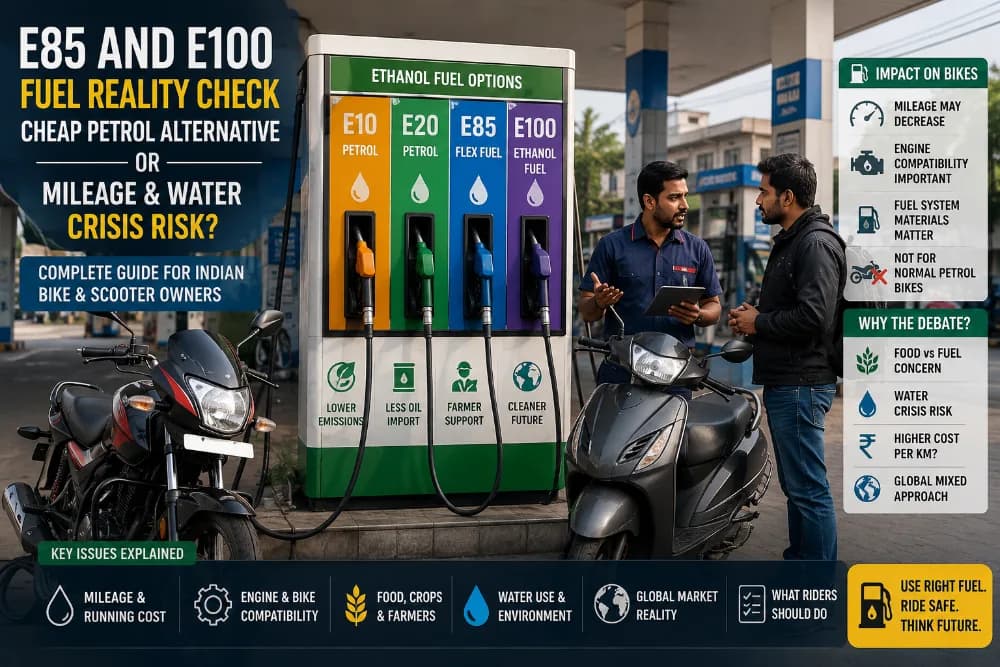
Ethanol fuel has suddenly become one of the biggest topics in India’s automobile market. After E20 petrol, the discussion has now moved to E85, E100 and flex-fuel vehicles. Government messaging says ethanol can reduce crude oil imports, support farmers, cut emissions and make fuel cheaper for consumers. On the other side, many vehicle owners, experts and media reports are asking difficult questions about mileage drop, old vehicle compatibility, food crops, land use and water pressure. So what is the truth? The reality is not black and white. Ethanol fuel is not a scam, and it is not a miracle either. It can work well in vehicles designed for it. But if a normal petrol bike or scooter is forced to run on high-ethanol fuel like E85 or E100 without proper compatibility, it can create real problems. This article gives a practical reality check for Indian bike owners, especially those who want to understand E85 and E100 beyond headlines.
What Are E85 and E100 Fuels?
Ethanol-blended fuel is petrol mixed with ethanol, an alcohol-based fuel mostly produced from crops such as sugarcane, maize, rice or other biomass. The number after “E” shows the ethanol percentage. E10 means around 10% ethanol. E20 means around 20% ethanol. E85 means a high-ethanol fuel, usually around 80–85% ethanol in India’s new rollout. E100 means almost pure ethanol or very high ethanol fuel. E20 is now the mainstream discussion for normal petrol vehicles in India. But E85 and E100 are different. They are meant for flex-fuel vehicles that are designed to run on high ethanol blends. This difference is very important. A bike that can run on E20 is not automatically safe for E85 or E100. High ethanol fuel needs different material compatibility, fuel injection calibration, fuel pump capacity, engine tuning and cold-start strategy.
Current Market Reality in India
India has moved very fast on ethanol blending. Government data says ethanol blending increased from around 1.5% in 2014 to 20% today, with the E20 target achieved ahead of the earlier schedule. The government claims this has saved large foreign exchange, reduced crude oil substitution and added income to farmers. Now India has started the next step: E85. In June 2026, E85 rollout started across selected public sector fuel outlets. The fuel is meant for flex-fuel vehicles, not normal petrol vehicles. The plan is to expand E85 availability from a small number of outlets to hundreds and then thousands of outlets in the next few years. This means India is not yet in a fully mature E85 market. It is in the early rollout stage. For consumers, the current reality is simple: E85 may be cheaper per litre, but it is not available everywhere. Only flex-fuel vehicles should use it. Normal petrol bikes should not use E85 or E100 unless the manufacturer clearly approves it. Mileage will be lower compared to petrol because ethanol has lower energy content. The real saving depends on cost per kilometre, not only price per litre.
Why E85 Looks Cheap but May Not Always Save Money
One of the biggest attractions of E85 is price. If E85 is much cheaper than petrol, riders may think it will automatically reduce running cost. But fuel economy changes the calculation. Ethanol has lower energy content than petrol. That means one litre of ethanol does not take you as far as one litre of petrol. International fuel data shows that E85 has significantly lower energy per gallon than gasoline, and E100 has even lower energy content. In simple words, your vehicle may burn more fuel to travel the same distance. For example, if a petrol bike gives 50 km/l on normal petrol, a flex-fuel version running on E85 may give lower mileage. The exact drop depends on engine design, ethanol percentage, riding style, tuning and traffic condition. So the right question is not: “Is E85 cheaper per litre?” The right question is: “What is my cost per kilometre after mileage drop?” If E85 is 20% cheaper but mileage also drops close to 20–25%, the real saving may become small. If the vehicle is specially optimized for ethanol, the loss can be reduced. But in normal engines, ethanol’s lower energy content is a real factor.
Impact on Bikes and Scooters
For bike owners, the biggest concern is compatibility. A normal petrol bike is designed around petrol or limited ethanol blends. When ethanol percentage rises, the fuel behaves differently. It affects combustion, air-fuel ratio, fuel pipes, seals, injectors, fuel pump, rubber parts and engine calibration. High ethanol fuel can absorb moisture more easily than petrol. It can also interact differently with certain materials. Modern flex-fuel vehicles use ethanol-compatible parts, but older or non-compatible bikes may not. Possible problems in non-compatible bikes include: Hard starting Rough idling Poor pickup Higher fuel consumption Fuel pump stress Injector mismatch Rubber seal damage Fuel pipe swelling or hardening Corrosion risk in sensitive parts Engine running lean Check-engine light in advanced vehicles This does not mean ethanol always damages engines. It means high ethanol fuel should be used only in vehicles designed for it.
E85 vs E100: Which Is Riskier for Normal Bikes?
E85 is already a high-ethanol fuel. E100 is even more demanding. E100 is almost pure ethanol, so a normal petrol bike should not be filled with it. A vehicle that runs on E100 needs specific engine mapping, fuel delivery capacity, compatible materials and proper starting strategy. For daily riders, the rule should be very clear: If your bike manual does not approve E85 or E100, do not use it. Even if the fuel is cheaper, the repair risk may be higher than the saving.
Why Are Many Big Powerful Countries Not Fully Using E85 or E100?
This is one of the most important questions. If ethanol is so good, why are all rich and powerful countries not running everything on E85 or E100? The answer has many layers. First, many high-income countries are now moving faster toward electric vehicles, hybrids, renewable diesel, sustainable aviation fuel and hydrogen in some segments. Because of this, their long-term petrol fuel demand is not growing like India’s. In mature markets, governments may not want to invest heavily in a new E85/E100 ecosystem when the transport future is moving toward electrification. Second, E85 needs dedicated infrastructure. Fuel stations need compatible tanks, pumps, nozzles, labels and storage systems. Retailers will invest only if there is enough consumer demand. If very few flex-fuel vehicles are on the road, fuel stations hesitate. If fuel stations do not offer E85, consumers hesitate to buy flex-fuel vehicles. This chicken-and-egg problem slows adoption. Third, high ethanol fuel has a mileage penalty. Consumers compare cost per kilometre. If the price gap is not enough, people may choose petrol even if their vehicle can run on E85. Fourth, food-vs-fuel concerns are real. Ethanol made from corn, sugarcane, rice or other food crops competes with food, feed, land, fertilizer and water. Rich countries with strict environmental and food-security debates often face strong pushback when crop-based fuels are expanded too aggressively. Fifth, many countries prefer low or moderate blending instead of very high blending. E10 and E15 are easier to blend into the existing fuel system. E85 and E100 need a much more specialized vehicle and fuel network. This is why countries may produce ethanol but still not make E85/E100 the default fuel for everyone.
Brazil Is the Exception, Not the Global Rule
Brazil is often used as the success story for ethanol. And yes, Brazil is the strongest example of high ethanol adoption. Brazil built its ethanol ecosystem over decades. It has sugarcane-based ethanol, flex-fuel cars, a supportive fuel-station network, policy backing and consumer familiarity. Many Brazilian vehicles can run on petrol-ethanol blends or hydrous ethanol. But Brazil’s case cannot be copied overnight. India has different crops, different water stress, different vehicle fleet, different fuel distribution and a very large two-wheeler market. A flex-fuel ecosystem can be built in India, but it needs time, honest consumer education and proper vehicle compatibility.
The US Produces Huge Ethanol, But E85 Is Still Not the Main Fuel
The United States is one of the world’s largest ethanol producers. It has millions of flex-fuel vehicles. Still, E85 is not the main fuel used by most drivers. Why? Because most fuel sold is still lower ethanol blend. E85 stations are not everywhere. Many consumers do not know their vehicle is flex-fuel. Mileage drops on E85. In many areas, the price difference is not strong enough to convince daily users. This shows an important lesson for India: production capacity alone does not guarantee consumer adoption. The fuel must be available, affordable per kilometre, supported by compatible vehicles and clearly explained to users.
Is Media “Threatening” Government Over Ethanol?
A better word is not “threatening.” Media and experts are warning, questioning and fact-checking the policy. Indian and global reports have raised concerns about three main areas: Vehicle compatibility Mileage and consumer cost Food, land and water pressure This is not automatically anti-government or anti-farmer. It is part of policy debate. A fuel policy affects millions of people: riders, car owners, farmers, oil companies, distilleries, food markets, water resources and the environment. So media scrutiny is natural. The government highlights benefits like lower crude imports, farmer income and lower emissions. Critics highlight risks like mileage loss, no lower-blend choice for older vehicles, water-intensive crops and food crop diversion. Both sides should be discussed.
Water Crisis: The Most Serious Hidden Question
The biggest long-term concern around ethanol in India is water. India already faces groundwater stress in many regions. Sugarcane and paddy are water-intensive crops. Government-linked ethanol roadmap documents themselves have noted that sugarcane is water intensive and that one litre of ethanol from sugar may require thousands of litres of water when crop cultivation water is included. This does not mean every litre of ethanol directly “drinks” that much water in a factory. The larger water footprint comes from growing the crop. The concern is this: If ethanol demand encourages more sugarcane, rice or maize cultivation in water-stressed areas, the fuel may reduce oil imports but increase water stress. This is why many experts ask India to focus more on less water-intensive feedstocks, agricultural waste and second-generation ethanol instead of relying too much on food crops.
Food vs Fuel: Is It a Real Issue?
Yes, it can become a real issue if not managed carefully. Ethanol from sugarcane, maize and rice is called first-generation ethanol. It is easier to produce, but it depends on crops that also connect to food, animal feed, land use and farmer crop choices. If food crops are diverted to fuel, it can affect grain availability, animal feed markets and crop prices. If farmers shift land from oilseeds or pulses to maize because ethanol demand is better, it can affect edible oil or protein crop goals. This is not a simple “good or bad” issue. Farmers need income, India needs lower oil imports, and consumers need affordable fuel. But food security and water security cannot be ignored. The better long-term solution is to increase second-generation ethanol from agricultural waste, crop residue and non-food biomass. But 2G ethanol is still expensive and difficult to scale because collection, storage, transport, enzymes and processing costs are high.
Is Ethanol Really Cleaner?
Ethanol can reduce some emissions, especially when used in properly designed engines. It can reduce carbon monoxide and particulate matter in many cases. Higher octane can also help engines run more efficiently if they are optimized for ethanol. But the full climate benefit depends on how ethanol is produced. If ethanol comes from efficient sugarcane or waste biomass, the climate benefit can be stronger. If it comes from water-intensive or fertilizer-heavy food crops, and if land-use change is involved, the benefit can become weaker. That is why lifecycle emissions matter. It is not enough to look only at tailpipe emissions. A fuel may burn cleaner in the engine but still have hidden environmental costs in farming, irrigation, fertilizer, processing and transport.
What Should Bike Owners Do Today?
For normal bike and scooter owners, the safest advice is simple: Use only the fuel approved by your vehicle manufacturer. If your bike is old and the manual says E5 or E10, be careful with higher blends. If your bike is E20-compatible, use E20 as per manufacturer guidance. If your bike is a flex-fuel model, follow the company’s instructions for E85 or E100. Do not experiment with E85 or E100 in a normal petrol bike just because the fuel is cheaper. Before buying a flex-fuel bike, ask these questions: Which ethanol blends are officially supported? What mileage can I expect on petrol vs E85? Is E85 available near my home or office? Will the warranty cover E85 and E100 use? Are service centers trained for flex-fuel systems? Are fuel-system parts easily available? What is the real cost per kilometre? These questions matter more than marketing slogans.
What Government Should Do to Build Trust
If India wants E85 and E100 to succeed, the policy must be consumer-friendly and transparent. First, fuel pumps should clearly label which vehicles can use which fuel. Many riders do not understand E20, E85 or E100 properly. Second, older vehicles should have clear guidance. Consumers should not be forced into confusion. Third, flex-fuel vehicles should publish real-world mileage data on petrol, E20 and E85. Fourth, E85 pricing should be low enough to compensate for mileage loss. Fifth, water-stressed crops should not become the main foundation of fuel expansion. Sixth, India should invest more seriously in 2G ethanol from crop waste and non-food biomass. Seventh, service centers and local mechanics should be trained for ethanol-related diagnosis. Without these steps, ethanol can become a trust problem even if the policy has good intentions.
Final Verdict: Is E85/E100 Good or Bad?
E85 and E100 are neither fully good nor fully bad. They are useful fuels for the right vehicles, under the right policy, with the right feedstock strategy. For flex-fuel bikes and cars, E85 can be part of India’s future. It can reduce imported oil dependency, support domestic ethanol production and offer lower pump prices if priced correctly. But for normal petrol bikes, E85 and E100 are not safe unless the manufacturer approves them. For India as a country, the biggest challenge is not just engine technology. The bigger challenge is balancing energy security, farmer income, consumer cost, food security and water security. Ethanol can be a smart bridge fuel. But it should not become a blind race. The real question is not whether India should use ethanol. The real question is how India can use ethanol without hurting riders, water resources, food markets and long-term sustainability.
Frequently Asked Questions
Fiixup Tip
If a fuel change, ethanol blend or otherwise, has left your bike hard to start, rough at idle, or losing power, a doorstep engine diagnostic check can confirm whether it's actually the fuel or something else before you spend on repairs you may not need.
Smirty Reddy
Fiixup Contributor
Need a Mechanic Right Now?
20-Min Quick Arrival* for eligible bookings after mechanic dispatch across Bengaluru, Chennai, Hyderabad & Mumbai. Available 24/7.
*Actual ETA may vary by traffic, location and mechanic availability.